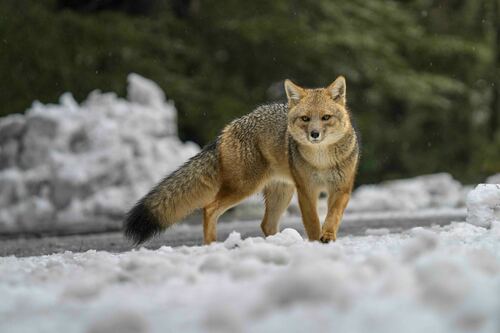
The Culpeo is the second largest canid in South America after the Maned Wolf. It is also one of the most altitudinally versatile: it is found from sea level to over 4000 metres in the Andes, tolerating temperatures and conditions that few carnivores of its size can withstand. Its distribution covers almost the entire north-south extent of the South American continent, from Ecuador to Tierra del Fuego, one of the widest latitudinal ranges of any wild canid in the world. In some rural areas, it has a reputation as a predator of sheep, which has led to historical conflict with Andean shepherds.
The Culpeo is a medium-large canid, the largest of the genus Lycalopex. Its fur is greyish on the head and back, with reddish tones on the legs and flanks, and a lighter throat and belly.
It can be confused with the notably smaller South American Grey Fox. In the extreme south of its range, it may also be confused with Darwin's Fox, which is similar in size but darker and more uniformly coloured.
An oval track 5-6.5 cm long, with four toes and distinct claw marks. It is larger than those of other South American foxes found in parts of its range. Elongated, twisted droppings 6-10 cm long, containing hair, bone remains and, in high-altitude areas, plant fibre. They are visibly deposited at mountain trail crossings. During oestrus, the Culpeo emits a sharp, repeated bark, audible from a distance in the silent high-mountain environments where it lives.
Very wide-ranging: from coastal scrub and desert at sea level to puna and Andean steppe above 4000 m. Distributed along the Andes mountain range and adjacent areas from Ecuador to the far south of Chile and Argentina, including Tierra del Fuego.
An opportunistic carnivore and omnivore, depending on availability: small mammals, birds, reptiles, insects, and fruit. In some livestock farming areas, it also takes lambs and livestock young, leading to conflict with pastoral activities.
Solitary outside the breeding season, with a large home range that can vary greatly depending on prey availability and altitude. Reproduction is highly seasonal in higher-altitude populations, with births concentrated in the austral spring.
The Culpeo maintains large and stable populations throughout most of its extensive South American range, with no signs of widespread species-level decline.
Direct persecution due to conflict with sheep farming in Andean areas, hunting for its fur in some regions, and roadkill in areas of expanding road infrastructure.
See all species accounts for carnivores · Full species index
Mammaling is a free app for logging the mammals you find. You record a sighting in a moment — even if it's just a track — your life list grows, and the record becomes available to scientific and conservation projects.
It runs on your phone with nothing to install. If you like, it adds to your home screen like any other app.
Open Mammaling