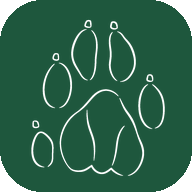
Illustration generated with artificial intelligence from reference sources and reviewed by the team. Use it as a guide, not as a definitive identification key: it may contain errors in anatomical details such as the number of toes, claw marks or the scale. If something looks off, write to us at [email protected]: corrections from people who know the field are what keep improving these plates.
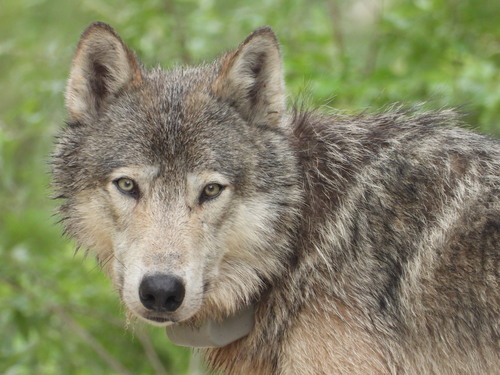
Few mammals have generated as much fear and fascination in equal measure as the Gray Wolf, the wild ancestor of all domestic dogs alive today.
It lives in extraordinarily organised family packs, communicating with such sophistication that its howls can travel several kilometres to coordinate dispersed members.
It was exterminated from much of Europe and North America throughout the 19th and 20th centuries. Its recent return to territories from which it had been absent for decades is one of the most discussed, and most controversial, large carnivore recovery processes in current conservation.
A large, robustly built canid with fur varying from grey to brown, black or almost white depending on the region, erect, triangular ears and a long tail carried low when walking. It differs from similarly sized Domestic Dogs by its proportionally longer legs, narrower chest and a much more efficient, sustained trot. It is confused with the Coyote or Jackal where they overlap; both are notably smaller and have finer muzzles.
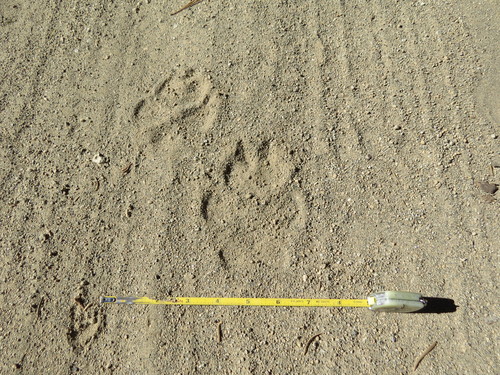
Large, oval track, 9-13 cm long, with four toes and visible claw marks. It is more elongated and has the central toes further forward than a large dog's track. A pack's tracks usually align almost in a single file when moving.
Cylindrical droppings, 8-15 cm long, containing hair and bone fragments. These are deposited visibly at crossroads and territory boundaries.
The group howl at dusk or dawn is the species' most unmistakable sign. It is used to gather the pack and mark territory against neighbouring packs.
Highly varied: boreal forest, tundra, steppe, mountain and desert. The Gray Wolf can adapt to almost any habitat where it finds sufficient prey and low human persecution.
Holarctic distribution, present in North America, Europe and Asia, with populations ranging from the polar circle to subtropical areas of the Near East.
A carnivore that hunts large ungulates in packs (Deer, Elk, Bison, Wild Sheep depending on the region), although it also catches small prey and eats carrion. Cooperative hunting allows it to take down prey much larger than a single individual could.
The Gray Wolf lives in hierarchical family packs, formed by a breeding pair and their young from different years. They defend a large territory, marked with howls, urine, and droppings. Only the dominant pair breeds in most packs, while the rest help raise the young. Some Arctic and Great Plains populations undertake seasonal movements, following the migrations of their prey.
The situation varies enormously by region: it maintains large, stable populations across much of Canada, Alaska, Russia, and Central Asia. It is clearly expanding and naturally recolonising several continental European countries since the late 20th century, thanks to legal protection. However, some peripheral and genetically isolated populations remain a cause for regional concern.
Direct persecution and poaching due to conflict with livestock farming, roadkill, habitat fragmentation by infrastructure, and hybridisation with feral dogs in some low-density areas.
See all species accounts for carnivores · Full species index
Mammaling is a free app for logging the mammals you find. You record a sighting in a moment — even if it's just a track — your life list grows, and the record becomes available to scientific and conservation projects.
It runs on your phone with nothing to install. If you like, it adds to your home screen like any other app.
Open Mammaling