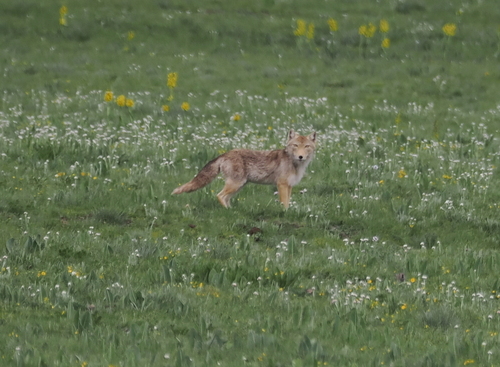
The Tibetan Fox has one of the most peculiar faces in the genus Vulpes: almost square, with a short, wide muzzle and small, close-set eyes. Its silhouette distinguishes it at a glance from any other fox in the world.
It lives on some of the highest and most arid plateaus on the planet, in Tibet and adjacent areas. Here, it endures extreme temperatures and an oxygen scarcity that would make life difficult for most carnivores of similar size.
The Tibetan Fox closely follows Pika colonies, small rodent-like mammals that form the almost exclusive basis of its diet. Its presence in an area is often a good indicator of the abundance of these prey.
The Tibetan Fox is a medium-small species with a head unusually square and broad for the genus. Its fur is greyish-brown to reddish on the back and paler on the flanks, and it has a long, bushy tail with a white tip. It differs from other foxes in the region, such as the Red Fox, by its notably broader and squarer head and its somewhat smaller size.
Oval track, 4-5 cm long, with four toes and indistinct claws. Droppings are elongated and twisted, 5-8 cm long, composed almost entirely of Pika hair, deposited scattered across the high-altitude grasslands where the Tibetan Fox hunts. Its presence is often revealed by excavated Pika burrows, around which it can be seen waiting motionless for long periods. This is a very characteristic hunting technique for the species.
Alpine steppe, high-altitude grassland and semi-desert areas of the Tibetan Plateau, typically between 2500 and 5300 m altitude.
Distributed across Tibet and adjacent areas of China, Nepal, India (Sikkim, Ladakh) and Bhutan.
It feeds almost exclusively on Pikas, small rodent-like mammals very abundant in high-altitude grasslands, occasionally supplemented with other small vertebrates and insects.
Solitary or in pairs, with a large home range adjusted to the availability of Pika colonies.
It has been observed hunting in association with the Red Fox, or even with raptors that take advantage of prey escaping from each hunter. This is an unusual relationship of tolerance between carnivores.
It maintains large and stable populations across most of the Tibetan Plateau, though these are closely linked to Pika abundance. Pika control through poisoning campaigns in some areas has indirectly affected the Tibetan Fox.
Pika control campaigns using poisons that reduce their main food source, hunting for their fur in some areas, and degradation of high-altitude grasslands by overgrazing.
See all species accounts for carnivores · Full species index
Mammaling is a free app for logging the mammals you find. You record a sighting in a moment — even if it's just a track — your life list grows, and the record becomes available to scientific and conservation projects.
It runs on your phone with nothing to install. If you like, it adds to your home screen like any other app.
Open Mammaling