Despite its name, the Crab-eating Fox does not live solely on crabs, although it can descend to mangroves and wetlands to catch them when the opportunity arises. It is a modest-sized, very adaptable South American canid that has successfully moved into agricultural and peri-urban areas as its original habitat was transformed. It forms pairs that remain together for years and hunt cooperatively, an unusual sight among wild canids of its size.
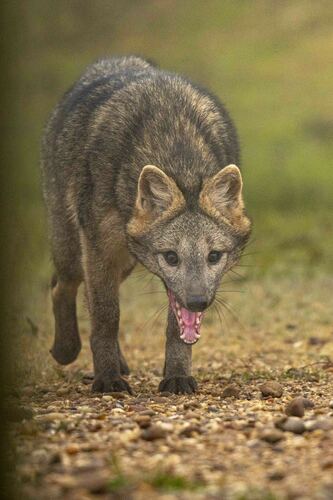
The Crab-eating Fox is a small to medium-sized canid. It has brownish-grey fur with yellowish tones on its legs, and a dark stripe along its back and tail, ending in a distinct black tip. It can be confused with other similarly sized South American canids, but is distinguished by its relatively short legs and somewhat stocky appearance compared to species of the genus Lycalopex.
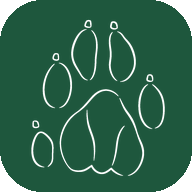
Small, oval track, 3.5-4.5 cm long, with 4 toes and distinct claws, similar to that of a small fox. Elongated droppings, 5-8 cm long, containing fruit, insect and hair remains, deposited scattered along its routes through the home range.
It hunts in coordinated pairs. It is often heard at night giving a sharp, repeated bark, very different from the howl of other larger South American canids.
Highly varied: savannah, gallery forest, wetland, scrubland and agricultural areas, showing good tolerance of human-altered environments. Found across much of South America east of the Andes, from Colombia and Venezuela to central Argentina and Uruguay.
Opportunistic omnivore: small vertebrates, insects, crabs and other invertebrates from wetland areas, fruit and carrion. Its diet varies greatly with season and local availability.
It forms stable pairs that hunt and move together, defending a shared territory. It is primarily nocturnal and crepuscular. In some areas with hunting pressure, it has become notably more diurnal where there is no persecution.
It maintains large and stable populations throughout most of its South American home range, favoured by its great adaptability to human-altered habitats.
Roadkill in areas of agricultural and urban expansion, transmission of diseases from domestic dogs (rabies, distemper), and bycatch in traps set for other species.
See all species accounts for carnivores · Full species index
Mammaling is a free app for logging the mammals you find. You record a sighting in a moment — even if it's just a track — your life list grows, and the record becomes available to scientific and conservation projects.
It runs on your phone with nothing to install. If you like, it adds to your home screen like any other app.
Open Mammaling