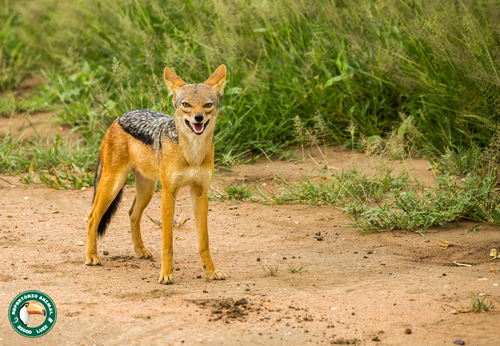
The Black-backed Jackal is the most vocal jackal in Africa. Its duet howls between pair members, synchronised with remarkable precision, are among the most recognisable nocturnal sounds of the savannah and bushland of southern and eastern Africa. It is distinguished from other African jackals by a striking dark, silver-streaked 'saddle' across its back, as if wearing a blanket. It lives in two populations, completely separated by thousands of kilometres: one in the Horn of Africa and the other in the south of the continent, with almost no genetic contact between them for a very long time.
Small to medium-sized canid with a striking black saddle, streaked with white or silver, on its back, which contrasts with the rest of its reddish-brown body, and large, erect ears. It is confused with the Striped Jackal, with which it shares part of its range in southern and eastern Africa, but the latter does not have such a distinct black saddle and does have a pale stripe on its flanks.
Track similar to that of a small fox, 4-5 cm long, with four toes and distinct claws, and narrower than that of a similarly sized domestic dog. Droppings are elongated and twisted, 5-8 cm long, containing hair and insect remains, and deposited in visible locations as a territorial mark. At night, it emits characteristic high-pitched howls, often in chorus between pairs or family groups, which is one of the most reliable indications of its presence.
Open savanna, arid scrubland and semi-desert. Distributed in two very separate populations on the African continent, one in northeast Africa (Horn of Africa) and the other in southern Africa, with a gap of thousands of kilometres between them.
Opportunistic omnivore: It hunts small vertebrates and insects, eats fruit and carrion, and in livestock areas may prey on young sheep and goats.
Black-backed Jackals live in monogamous pairs that defend a territory year-round, sometimes with young from previous litters helping to raise new ones. Highly territorial, they actively mark boundaries with urine and droppings.
The Black-backed Jackal maintains large and stable populations throughout most of its range, making it one of the most adaptable African canids and least affected by human pressure.
Conflict with livestock leads to control (hunting, trapping, and poisoning) in some regions of southern Africa. There are no significant global threats.
See all species accounts for carnivores · Full species index
Mammaling is a free app for logging the mammals you find. You record a sighting in a moment — even if it's just a track — your life list grows, and the record becomes available to scientific and conservation projects.
It runs on your phone with nothing to install. If you like, it adds to your home screen like any other app.
Open Mammaling