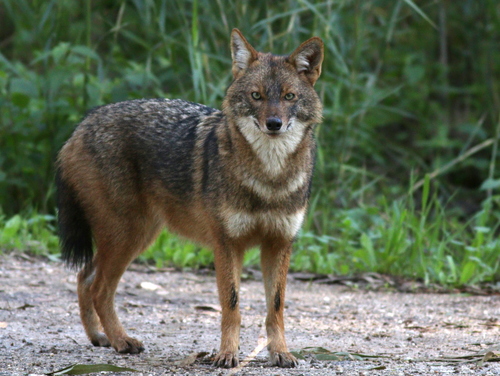
The Golden Jackal is the wild canid most rapidly expanding its range in Europe. In recent decades, it has naturally colonised countries from the Balkans to the centre of the continent, where it had never been seen before, without human reintroduction.
It is smaller and less robust than the Wolf, but shares its habit of howling to communicate over distance. This high-pitched, prolonged sound has become a common part of the night in many areas of Asia and southeast Europe.
It lives in stable pairs for years, which is uncommon among canids of its size.
Small to medium-sized canid with golden-brown fur, greyish tones on the back, and lighter fur on the flanks and belly. It has large, erect ears. It can be confused with the Black-backed Jackal and the Red Fox where their ranges overlap. However, the Golden Jackal is stockier and has a wider muzzle than the Red Fox. It also lacks the characteristic dark "saddle" of the Black-backed Jackal.
Track similar to a small dog's, 4.5-6 cm long, with four toes and distinct claws. Droppings are elongated and somewhat twisted, 6-9 cm long, containing hair, fruit remains, and small bones, deposited in visible locations as a territorial mark.
At night, the Golden Jackal emits a high-pitched, prolonged howl, often answered in chorus by neighbouring pairs. This sound is very distinct from the deep howl of the Wolf and is very useful for detecting its presence without seeing it.
Highly varied: savannah, steppe, dry scrub, agricultural land, and wetland edges, showing good tolerance of human presence.
It is widely distributed from southeast Europe and North and East Africa to the Near East, Central Asia, and the Indian subcontinent. Its range has recently expanded notably into Central and Northern Europe.
Opportunistic omnivore, feeding on small vertebrates, insects, fruit, and carrion. In some areas, it also takes human-derived remains and young livestock in specific circumstances.
Forms stable monogamous pairs that defend a territory for years, sometimes with the help of young from previous litters in raising subsequent litters. Highly vocal, it uses chorus howling to reinforce pair bonds and mark territory against other pairs.
The Golden Jackal maintains stable populations in most of its traditional range. It has been clearly expanding towards central and northern Europe since the late 20th century, favoured by the abandonment of agricultural land and reduced direct persecution in several countries.
Culling due to conflict with livestock farming in some regions and roadkill in areas of recent expansion, with no significant global threats.
See all species accounts for carnivores · Full species index
Mammaling is a free app for logging the mammals you find. You record a sighting in a moment — even if it's just a track — your life list grows, and the record becomes available to scientific and conservation projects.
It runs on your phone with nothing to install. If you like, it adds to your home screen like any other app.
Open Mammaling