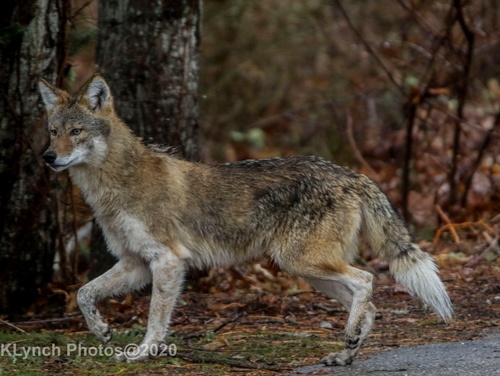
The Coyote is one of the few large American carnivores whose home range has expanded dramatically in the last century, rather than shrinking. It has colonised cities, urban parks, and even areas where it had never before been recorded, as the disappearance of Wolves and other large predators left the territory open.
It communicates with a very characteristic, high-pitched, broken howl. This is distinct from the deeper, more sustained howl of the Wolf, and can be heard at dusk in rural areas and, increasingly, on the outskirts of large North American cities.
It is an opportunistic hunter, able to adapt its diet to virtually any available resource, from small rodents to fruit or urban refuse. This flexibility largely explains its remarkable ecological success.
Its increasing presence in human environments has generated both fascination and conflict, especially in areas where it interacts with pets or small livestock.
Medium-sized canid, smaller and more slender than a Wolf, with large, pointed ears, a narrow muzzle, and a long, bushy tail carried low when running. It differs from the Wolf by its distinctly smaller size and more graceful build. It differs from the Domestic Dog by its narrower muzzle, more erect ears, and lower, bushier tail.
Oval track, 5-7 cm long, with 4 toes and visible claw marks. It is more elongated and narrower than that of a similarly sized domestic dog, with the plantar pads closer together. When trotting, its tracks follow a very defined straight line, unlike a dog's more erratic tracks.
Elongated and twisted droppings, 6-10 cm long, often with visible hair, bone, or seeds. These are left prominently at trail junctions or on elevated points as a territorial mark.
It leaves scrapes on the ground after defecating. The Coyote howls at dusk with a high-pitched, broken pattern, very distinct from the deep, sustained howl of the Wolf.
Found in a wide variety of habitats, from prairie and desert to forest, mountain, and urban and peri-urban areas. Its range covers much of North and Central America, from Alaska to Panama, and has been continuously expanding in recent decades.
An opportunistic omnivore, the Coyote feeds on small and medium-sized mammals, birds, fruit, carrion, and even urban refuse in peri-urban areas. It adapts its diet to the resources available in each habitat.
The Coyote lives alone, in pairs, or in small family packs, depending on resource availability and hunting pressure in the area. It communicates using howls, barks, and yelps, and its breeding season usually coincides with winter or early spring, depending on the region.
Its populations have expanded notably in the last century, colonising new areas in North and Central America as other large predators disappeared from those territories. There are no signs of decline anywhere in its wide home range.
It faces no significant threats at species level; locally, its population is controlled due to conflict with small-scale livestock farming and roadkill in areas of intense traffic.
See all species accounts for carnivores · Full species index
Mammaling is a free app for logging the mammals you find. You record a sighting in a moment — even if it's just a track — your life list grows, and the record becomes available to scientific and conservation projects.
It runs on your phone with nothing to install. If you like, it adds to your home screen like any other app.
Open Mammaling