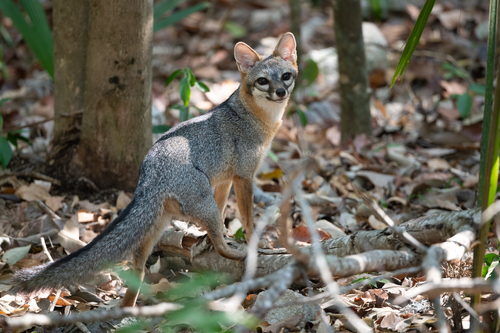
It is the only American cane capable of climbing trees with soltura, thanks to a semi-retractable tail and a flexible muzzle that allows it to embrace the trunk and climb several meters in search of shelter, fruit or to escape from a coyote. It lives in the forest, rocks and rocky areas of much of the American continent, and its gray coat vetated with a black strap along the back and tail gives it a very different appearance to the rest of foxes in its area. It is one of the oldest living cane from the evolutionary point of view, a lineage that separated very soon from the rest of the family of dogs and foxes.
Canyon small-medium size, gray fur veised on the back with red tones on the flanks and neck, and a black strip that goes through the back to the tip of the tail, also black. It differs from red fox by that dark dorsal strap and by lacking white at the tip of the tail characteristic of this latter, and other canids of its area by its ability to climb trees, something that none of them does.
Fingerprint with 4 fingers and fingerprints visible but little deep, 3-4 cm, smaller and rounded than that of a coyote and with a more irregular pattern of walking than that of this. Extended and twisted excrete, 5-8 cm, with seed of fruit and hair visible, often deposited in high spots such as rocks or the base of trees used to climb. The most diagnostic sign is the evidence of the trap itself: garlic marks on the cortex of inclined trunks, and sometimes excrete or food remains found several meters above the ground in tree holes, something that no other canyon in its area leaves.
Forest, grassland, rocky areas and field edge, from low lands to middle mountain heights. Distributed from southern Canada to northern South America, with a wide distribution in North America and Central America.
Omnivorous, it feeds on small mammals, birds, invertebrates and a high proportion of fruit in autumn, when it can become the main component of its diet.
Solitary or in couples, of activity mainly night and crepuscular, and territorial throughout the year.It is the only American canyon that treats trees regularly, using that ability both to feed and to refuge from predators such as the coyote.
Its populations are generally considered stable in most of its wide distribution area, although it locally competes for the territory with the coyote, whose expansion in some areas can displace gray fox populations.
It does not face significant threats at species level; locally suffers road crashes and is occasional carrier of rabies and backpack.
See all species accounts for carnivores · Full species index
Mammaling is a free app for logging the mammals you find. You record a sighting in a moment — even if it's just a track — your life list grows, and the record becomes available to scientific and conservation projects.
It runs on your phone with nothing to install. If you like, it adds to your home screen like any other app.
Open Mammaling