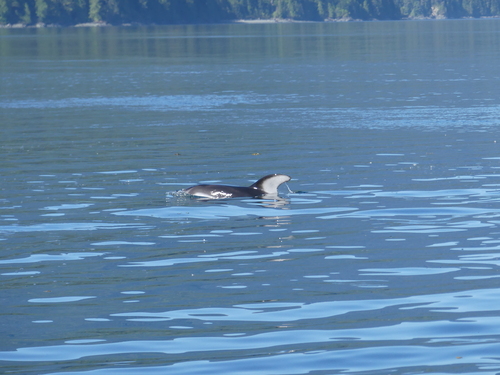
It is one of the most acrobatic dolphins in the northern Pacific, capable of large jumps, twists and swings out of the water, and often spontaneously approaches the proa of moving boats to surfe the wave they generate, a behavior that makes it one of the most easy to observe cetaceans in the high seas within its area. It lives in very numerous groups, sometimes several hundred individuals, who move together through the temperate and cold waters of the northern Pacific in search of fish banks and calamar. Its scientific name has changed recently: for decades it was included in the genus Lagenorhynchus along with other similar pattern dolphins, but recent genetic and morphological analysis has led it to transfer to its own genre, an example of how the taxonomy of cetaceans continues even in well
Small-medium-sized dolphin, robust and rugged body, with black back, gray flanks with an elongated white strip, and a curved two-tone dorsal aleta, dark in front and clear behind. It differs from other dolphins in its area by that pattern of color in several tones and by the markedly curved shape of the dorsal aleta, very different from the straight aleta of other sympathetic species.
It does not leave traces by being a strictly marine cetacean; its presence is recognized by its very active behavior on the surface, with large jumps and turns out of the water much more frequent than in most dolphins in its area, and by forming very numerous and cohesion groups that often include other species of cetacean swimming alongside them.
Warm and subarctic waters of open sea and continental platform, mainly in cold and productive waters. Distributed in the northern Pacific, from Japan and Russia to Alaska, Canada, the United States and northern Mexico.
It feeds on bank fish and medium-water calamari, caught in cooperative hunting within the large groups in which it moves.
It lives in very numerous and cohesive groups, often several dozen to several hundred individuals, which are sometimes associated with other species of cetacean or with larger whales.It is very active on the surface, with frequent jumps and acrobatics, and performs seasonal displacements related to the availability of prey more than a fixed migration.
Its populations are generally considered stable in most of its distribution area in the northern Pacific, with no signs of significant decline on a global scale.
Accidental catch in fishing gear and seizure, and possible competition with commercial fishing for the same fish and calamity resources.
See all species accounts for even-toed ungulates · Full species index
Mammaling is a free app for logging the mammals you find. You record a sighting in a moment — even if it's just a track — your life list grows, and the record becomes available to scientific and conservation projects.
It runs on your phone with nothing to install. If you like, it adds to your home screen like any other app.
Open Mammaling