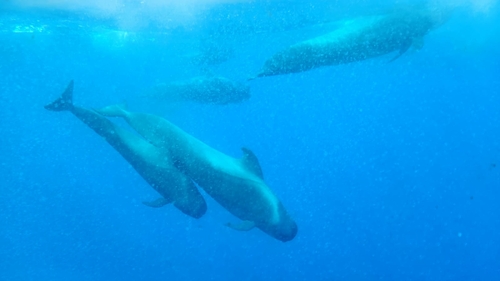
The Short-finned Pilot Whale is the pilot whale of warm seas, a tropical and subtropical version of a large, round-headed delphinid. An almost identical relative occupies colder waters of the planet. They share almost everything except pectoral fin length and the water temperature range they inhabit. Like its relative, it forms highly cohesive matriarchal societies. In these, older females stop reproducing long before they die, dedicating themselves to helping raise subsequent generations. It is one of the most studied species in some areas of the Pacific. This is thanks to resident coastal populations that allow long-term individual monitoring, which is unusual among large oceanic delphinids.
A large delphinid with a robust, black or very dark grey body. It has a pale anchor-shaped patch under the chin, a domed, rounded head with no distinct beak, and a low, very forward-set dorsal fin.
It is practically identical to the Common Pilot Whale. It differs from that species by its proportionally shorter pectoral fin and its distribution in warmer tropical and subtropical waters, compared to the temperate and subpolar waters of its relative.
It leaves no tracks on land. It is detected by a low, frontal blow, followed by a slow emergence of the back, showing the low, forward dorsal fin characteristic of the genus. It is very social and usually sighted in compact groups swimming very close to each other, with surface behaviour similar to that of its cold-water relative. Underwater, it emits whistles and echolocation clicks used for social cohesion and hunting. Like its relative, it can be involved in mass strandings of entire family groups.
Deep tropical and subtropical oceanic waters, generally over the continental slope. Some resident coastal populations occur in deep waters close to the coast. Widely distributed in warm waters of the Atlantic, Pacific, and Indian Oceans, occupying the warmer latitudinal band which its cold-water relative does not inhabit.
It feeds primarily on squid, supplemented with deep-sea fish, caught during dives exceeding several hundred metres in depth.
Extremely social, the Short-finned Pilot Whale lives in stable matrilineal groups of dozens of individuals led by older females. Its social structure is very similar to that of its cold-water relative, including the presence of females that stop reproducing long before they die. Some coastal populations show notable fidelity to a small area, which has allowed long-term individual tracking studies.
Its populations generally remain numerous and stable throughout most of its tropical and subtropical range, with no signs of widespread decline. However, some specific coastal populations show strong exposure to local human activity.
Bycatch in deep-sea fishing gear, active traditional hunting in some areas of the Pacific and Caribbean, contamination by persistent compounds accumulated in its blubber, and mass strandings of causes not always clearly understood.
See all species accounts for even-toed ungulates · Full species index
Mammaling is a free app for logging the mammals you find. You record a sighting in a moment — even if it's just a track — your life list grows, and the record becomes available to scientific and conservation projects.
It runs on your phone with nothing to install. If you like, it adds to your home screen like any other app.
Open Mammaling