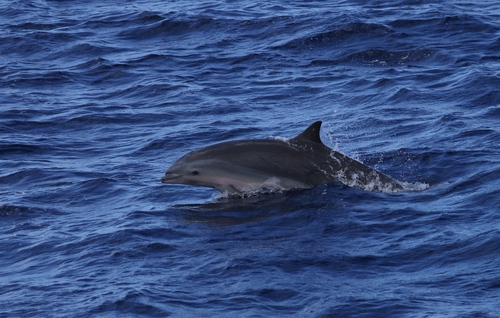
Fraser's Dolphin has a dark mask across its face and a distinct lateral stripe along its body. This characteristic pattern earns it the nickname "bandit dolphin" in some areas where it is sighted. For decades, Fraser's Dolphin was known almost exclusively from a single skeleton found in the late 19th century. However, from the 1970s onwards, live sightings began to be documented in warm waters worldwide. These revealed it to be a widespread species, not an isolated rarity as previously believed. Fraser's Dolphin lives in large, very compact groups in deep offshore waters. This gregarious behaviour facilitates its detection, despite its elusive individual behaviour.
Fraser's Dolphin is a medium-sized delphinid with a robust, stocky, brownish-grey body. It has a well-marked dark lateral stripe running along the flank from the eye to the anal region, more visible in adult males. A dark mask surrounds the eye. It has a short beak and pectoral fins proportionally small for its body size. This differentiates it from other lateral-striped dolphins, such as the Striped Dolphin, which has a longer beak and a more complex stripe pattern.
Fraser's Dolphin leaves no tracks on land. It is detected by a low blow, followed by a rapid emergence of its back with the triangular to slightly falcate dorsal fin clearly visible. It is almost always sighted in large, very compact groups, often of several hundred individuals swimming very close together at high speed. This gregarious and fast-moving behaviour facilitates its detection in open sea. Underwater, it emits whistles and echolocation clicks used for the cohesion of these large groups.
Deep tropical and subtropical oceanic waters, generally far from the coast and over the continental slope. Widely distributed in warm waters worldwide, with documented presence in the Atlantic, Pacific, and Indian Oceans.
Fraser's Dolphin feeds on fish, squid and crustaceans from mesopelagic waters, caught through relatively deep dives.
Highly social, Fraser's Dolphin lives in large, compact groups that can number several hundred individuals, often mixed with other oceanic dolphin species. It moves at high speed in open water, with fast, coordinated swimming behaviour characteristic of the group.
Fraser's Dolphin populations are generally considered numerous and stable across most of its tropical and subtropical oceanic range. There are no signs of widespread decline, although accurate population data remain limited in large areas of its distribution.
Bycatch in offshore fishing gear, especially in tropical tuna fisheries, and pollution by persistent compounds accumulated in its blubber.
See all species accounts for even-toed ungulates · Full species index
Mammaling is a free app for logging the mammals you find. You record a sighting in a moment — even if it's just a track — your life list grows, and the record becomes available to scientific and conservation projects.
It runs on your phone with nothing to install. If you like, it adds to your home screen like any other app.
Open Mammaling