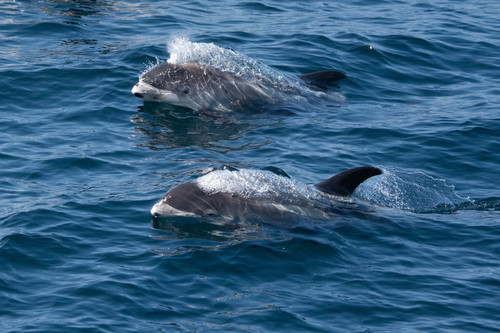
The White-beaked Dolphin is a robust, almost stocky, cold-water dolphin, adapted to swimming in the icy waves of the North Atlantic where more slender-bodied dolphins rarely venture. Its name refers to a short, thick beak which in many individuals is very visibly white. However, the colouring of this area varies considerably between populations, from pure white to greyish tones. This variation surprises those
The White-beaked Dolphin is a medium-sized dolphin with a robust, stocky dark grey body. It has white and greyish markings on its flank and caudal peduncle, a short, thick beak (often white though variable in colour), and a high, very falcate dorsal fin. It differs from the Striped Dolphin and other temperate-water dolphins by its much more robust body and its clear association with cold North Atlantic waters. It differs from the Atlantic White-sided Dolphin by its shorter, thicker beak and the flank's colour pattern, which has less yellowish contrast.
It leaves no tracks on land. It is detected by a low blow, followed by a powerful emergence of its back, with its high, very falcate dorsal fin clearly visible. The White-beaked Dolphin is a fast, active surface swimmer, with relatively frequent leaps and tail slaps. It often approaches boats curiously and accompanies large whales in their feeding areas. Underwater, it emits whistles and echolocation clicks, used for social cohesion and cooperative hunting.
Temperate and cold continental shelf waters of the North Atlantic, from coastal areas to more distant oceanic waters, with a preference for relatively cold and productive waters. Distributed throughout the North Atlantic, from the east coast of North America to the European and Arctic coasts, with no presence outside this oceanic basin.
It feeds on shoaling fish such as herring and capelin, as well as squid and benthic crustaceans, caught through cooperative group hunting.
Social, the White-beaked Dolphin lives in variable-sized groups, from a few individuals to several tens, often associating with other cetacean species, including large whales, in productive feeding areas. It undertakes seasonal movements related to prey availability and water temperature within its North Atlantic range.
Its populations generally remain numerous and stable in most of its North Atlantic range, with no signs of widespread decline, although some areas show some sensitivity to changes in the distribution of their prey associated with water warming.
Bycatch in fishing gear, especially gillnets, changes in prey distribution associated with warming North Atlantic waters, and pollution by persistent compounds accumulated in their blubber.
See all species accounts for even-toed ungulates · Full species index
Mammaling is a free app for logging the mammals you find. You record a sighting in a moment — even if it's just a track — your life list grows, and the record becomes available to scientific and conservation projects.
It runs on your phone with nothing to install. If you like, it adds to your home screen like any other app.
Open Mammaling