Illustration generated with artificial intelligence from reference sources and reviewed by the team. Use it as a guide, not as a definitive identification key: it may contain errors in anatomical details such as the number of toes, claw marks or the scale. If something looks off, write to us at [email protected]: corrections from people who know the field are what keep improving these plates.
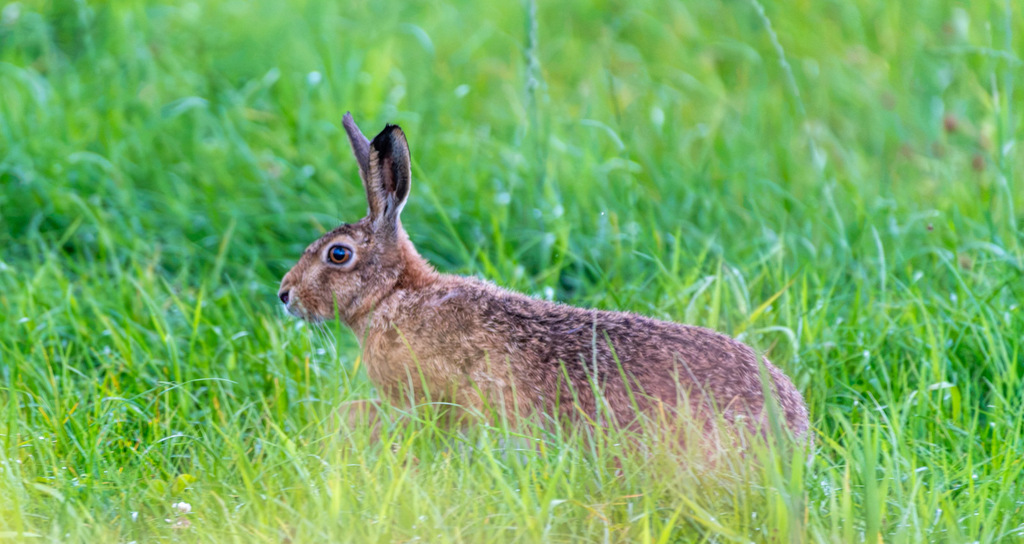
The European Hare is the most widespread hare in Europe and one of the most important prey for many of its predators, from the Golden Eagle to the Red Fox. It can reach speeds of over 70 km/h in a straight run, one of the highest among mammals of its size. In spring, it performs the famous 'boxing matches' between individuals, a courtship much more aggressive than its calm appearance suggests. Unlike rabbits, with which it is often confused, it is born already furred and with its eyes open, ready to fend for itself within days.
A medium-large European Hare. Its fur is reddish-brown, flecked with dark on the back, with a white belly. It has long ears with a distinct black tip, and the upper side of the tail is black. It differs from the Rabbit by its larger size and much longer ears and hind feet. It does not live in burrows but in simple surface forms.
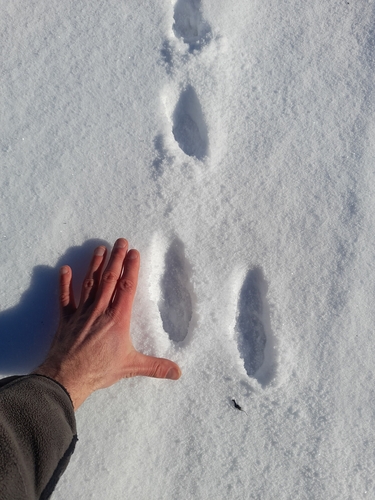
Very elongated hind tracks, 12-16 cm long, much larger than the fore tracks. They leave a characteristic bounding pattern with the fore tracks landing behind the hind tracks. Spherical, fibrous droppings, 1.3-1.8 cm long, slightly larger than those of a rabbit, are scattered in open grassland.
The European Hare shelters by day in a form, a simple depression in the ground among vegetation, without digging a burrow. In spring, pairs can be seen chasing and striking each other with their fore feet during courtship.
Open country, grassland, steppe and field margins, preferring mosaic landscapes combining grassy areas and cover vegetation. Native to Europe and parts of western Asia, and introduced to North America, South America, Australia and New Zealand.
Herbivorous: grass, tender cereal crops and vegetables in summer, and bark and woody shoots in winter when other vegetation is scarce.
The European Hare is solitary outside the oestrus period. During oestrus, males and females gather in temporary groups, engaging in well-known boxing disputes. Often, the female rejects the male by hitting him. It can have several litters a year. The precocial young are capable of fending for themselves much earlier than those of a Rabbit.
The European Hare maintains widespread populations in most of its home range, although notable declines have been documented in several intensive agricultural regions of Europe since the mid-20th century, partially offset by stable or increasing populations in other areas.
Agricultural intensification and loss of hedges and field margins, pesticide use which reduces its food and increases young mortality, roadkill, and hunting pressure in some regions.
See all species accounts for rabbits and hares · Full species index
Mammaling is a free app for logging the mammals you find. You record a sighting in a moment — even if it's just a track — your life list grows, and the record becomes available to scientific and conservation projects.
It runs on your phone with nothing to install. If you like, it adds to your home screen like any other app.
Open Mammaling