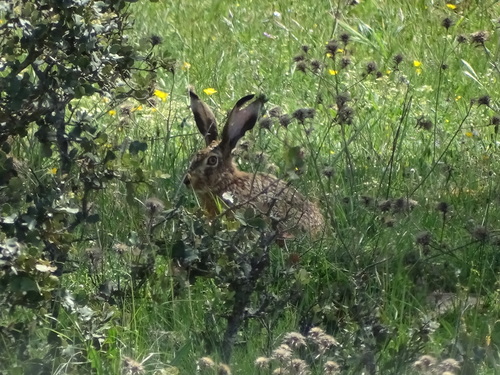
The Iberian Hare is native to southwest Europe. It is closely associated with the open landscapes of the Iberian Peninsula. Much of its recent evolutionary history has therefore unfolded in isolation from other European Hares, separated by the natural barrier of the Pyrenees.
It lives in the open all year round, without a fixed burrow, relying on camouflage and explosive acceleration to escape predators at the last possible moment. In areas of
A medium-sized lagomorph, somewhat smaller than the European Hare. It has greyish-brown fur on its back, a white belly, and the inner surface of its ears has less black at the tip than the European Hare. It differs from the Rabbit by its larger size, much longer ears with black tips, and longer hind legs adapted for running. It is difficult to distinguish from the European Hare, with which it overlaps in the north of its range, mainly by its slightly smaller size and details of its tail fur.
Elongated track, with the hind track notably larger than the fore track. Hind tracks are 8-11 cm long. The bounding gait pattern places the two hind tracks ahead of the fore tracks, very different from the regular trot of a Fox or a Dog.
Rounded, fibrous droppings, 1-1.5 cm long, left scattered throughout its home range without grouping in latrines.
It does not dig its own burrow. It rests in a small depression in the ground called a 'form', often next to a bank or clump of vegetation. This oval hollow, about 20-30 cm long, is itself a clear indication of its presence.
Open agricultural land, Mediterranean scrubland, grassland and dehesa, with a preference for mosaic landscapes with cultivation and natural vegetation, from sea level to mid-mountain areas. Endemic to south-western Europe, with distribution centred on the Iberian Peninsula and limited presence in southern France.
Herbivorous, it feeds on grass, cereal crops, legumes and woody shoots depending on seasonal availability. Its diet varies markedly between agricultural landscapes and natural scrubland.
Solitary outside the oestrus period, mainly active at dusk and during the night, the Iberian Hare has a large home range and no fixed burrow. It can have several litters a year in favourable conditions, with precocial young able to move shortly after birth. This contrasts with Rabbit young, which are born blind and naked in a burrow.
Its populations have suffered notable fluctuations linked to episodes of viral disease and changes in agricultural land use. However, it remains one of the most widespread small game species in its area without signs of widespread decline across the entire species.
Agricultural intensification, which reduces the availability of natural vegetation and field margins; use of agricultural machinery during the breeding season, which can destroy litters; and high hunting pressure in some areas.
See all species accounts for rabbits and hares · Full species index
Mammaling is a free app for logging the mammals you find. You record a sighting in a moment — even if it's just a track — your life list grows, and the record becomes available to scientific and conservation projects.
It runs on your phone with nothing to install. If you like, it adds to your home screen like any other app.
Open Mammaling