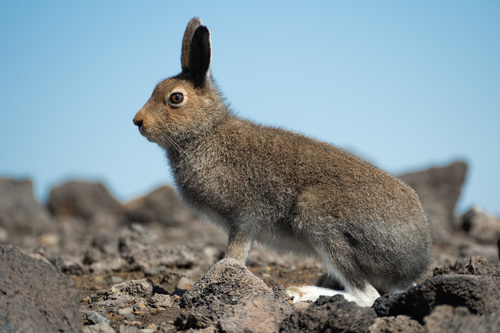
The Mountain Hare changes its coat with the seasons. In mountain and northern European populations, its fur turns from brown to an almost pure white in winter. This provides perfect camouflage on snow, a strategy that has worked for thousands of years.
It is a close relative of the European Hare, but much more adapted to extreme cold, capable of living in the tundra and on alpine peaks where few other herbivores can survive. Today, this white coat, once an evolutionary advantage, is becoming a problem: snow lasts for fewer weeks each year, leaving the Mountain Hare in white fur against brown ground.
The Mountain Hare is medium-sized, with shorter ears and less black on the tips than the European Hare. Its tail is always white, unlike the European Hare's, which has a black upper side. In summer, the fur is greyish-brown. In the most northerly and high-mountain populations, it moults to almost pure white in winter. However, in more temperate areas of its range, this moult is partial or even absent.
Rear tracks much longer than the front ones, 10-14 cm long, with the outline blurred by dense hair between the toes, especially visible in snow. Droppings are spherical and fibrous, 1-1.5 cm long, grouped in scattered piles in grassy areas. During the day, it shelters in day beds (forms), which are shallow depressions in vegetation or snow. In winter, it may excavate small burrows under the snow.
Tundra, mountain heathland, broom scrub, and boreal forest, with a boreal-alpine distribution: northern Europe (Scandinavia, Scotland, Ireland), the Alps, and isolated high-mountain populations further south.
In Scotland and Scandinavia, the Mountain Hare descends to elevations near sea level; in the Alps, it is restricted to areas above the treeline.
Herbivorous: heather, grass and, in winter, woody shoots and bark when other vegetation is scarce.
Solitary except during oestrus, mainly active at dusk and night. It does not migrate, but may move locally depending on snow cover. Several litters per year of 1-4 young (leverets), which are born precocial and able to move shortly after birth, unlike rabbits.
The Mountain Hare has large global populations, though marked declines are seen in some peripheral populations, such as those in the United Kingdom. There is also growing concern about the mismatch between its winter white moult and the shorter duration of snow cover due to climate change.
Climate change (increased visibility to predators due to moult mismatch with snow), heathland habitat loss, local hunting, and competition or hybridisation with the European Hare where both species overlap.
See all species accounts for rabbits and hares · Full species index
Mammaling is a free app for logging the mammals you find. You record a sighting in a moment — even if it's just a track — your life list grows, and the record becomes available to scientific and conservation projects.
It runs on your phone with nothing to install. If you like, it adds to your home screen like any other app.
Open Mammaling