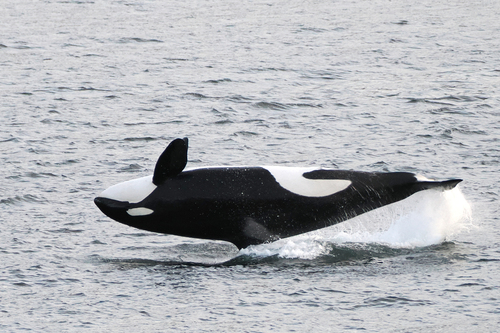
The Common Killer Whale is the world's largest dolphin and one of the planet's most versatile predators. Its populations are so specialised in specific prey, from salmon to large whales or sharks, that they do not even hunt in the same way or share an acoustic dialect, even when living in the same region.
This diversity is so profound that much of the scientific community debates whether what is currently considered a single species should be divided into several. The IUCN Red List itself acknowledges this debate by not yet being able to assign a defined conservation category.
It lives in very stable family groups, almost always led by an older female who can remain alive and active long after ceasing to reproduce, something exceptional among non-human mammals.
A large, unmistakable cetacean, with a black body and well-defined white patches behind the eye and on the belly. It has a large dorsal fin. In adult males, this fin can exceed 1.5 metres in height, and is much taller and straighter than the female's, which is curved backwards. The Common Killer Whale cannot be confused with any other cetacean due to its colouring pattern and the size of the male's dorsal fin.
It leaves no tracks on land. It is detected by its low, rounded blow, the synchronised appearance of several individuals at the surface when breathing, and the male's very tall dorsal fin, which is visible from a great distance even in rough seas. Underwater, it produces a wide variety of whistles, clicks, and pulsed calls specific to each family group, a type of dialect that researchers use to identify which population a specific group belongs to. In some populations specialised in marine mammals, Common Killer Whales can be observed deliberately stranding on beaches to capture prey, a hunting technique culturally transmitted between generations.
Occurs in all oceans and seas worldwide, from the Arctic to the Antarctic, both in coastal waters and in open sea. Within the same region, distinct populations are ecologically specialised in specific prey types and habitats.
Diet is highly variable depending on the population. It includes fish (including large sharks), squid, seals, other cetaceans, and even large whales in some specialised populations. These are caught using cooperative hunting techniques that are culturally transmitted between generations of the same group.
It lives in very stable family groups, led by older females. These females can live for several decades after ceasing to reproduce, continuing to provide key knowledge about feeding areas to the rest of the group. Social structure, acoustic repertoire, and hunting techniques vary greatly between populations, even among those sharing the same geographical region.
Insufficient global information exists to assign a threat category to the species as a whole, given the enormous ecological and genetic diversity among its populations. Some of these, assessed separately, such as that in the Strait of Gibraltar, are in a critical situation with very few breeding individuals. Other populations in the North Pacific or Atlantic are considered much more numerous and stable.
Pollution by persistent compounds that accumulate in fat and affect reproduction, overfishing of their prey in some regions, collision with vessels, bycatch in fishing gear, and, in some coastal populations, direct interactions with fisheries leading to conflict.
See all species accounts for even-toed ungulates · Full species index
Mammaling is a free app for logging the mammals you find. You record a sighting in a moment — even if it's just a track — your life list grows, and the record becomes available to scientific and conservation projects.
It runs on your phone with nothing to install. If you like, it adds to your home screen like any other app.
Open Mammaling