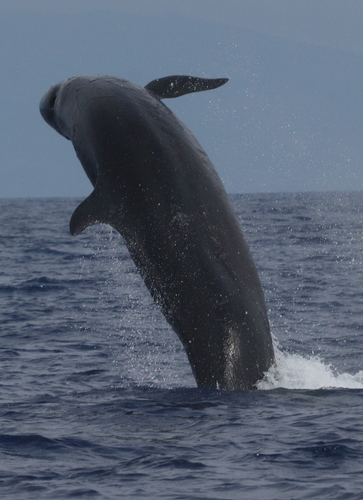
Despite its name, the False Killer Whale is not a Killer Whale but a large dolphin, black from head to tail, with a narrow, conical head that gives it an unmistakable profile in the water.
It is one of the few cetaceans capable of coordinating to hunt large prey such as tuna or even other dolphins. It has been observed sharing food with conspecifics, a gesture of cooperation unusual among marine predators.
It is also involved in one of the most puzzling phenomena in marine biology: mass strandings, in which tens or hundreds of individuals from the same social group become stranded together on the coast. The causes of this behaviour are still not fully understood.
A large delphinid with a slender, entirely black or very dark grey body. It has a narrow, conical head without a distinct beak, and a falcate dorsal fin located midway along the body. It differs from the Orca, which is much larger and has the characteristic black and white pattern, and from the Pilot Whale, which has a much more rounded, bulbous head. Its slender silhouette and uniform colour distinguish it from both with relative ease in good viewing conditions.
No deja huellas en tierra; it is detected by its surface behaviour, with occasional leaps and curious approaches to boats in coordinated groups. It emits series of echolocation clicks and whistles used in cooperative hunting and group social cohesion, audible with a hydrophone. The False Killer Whale is one of the cetacean species most associated with mass strandings. In these events, entire groups of tens or hundreds of individuals become stranded together on the coast. This phenomenon is in itself one of the clearest indications of its presence in a region.
Deep, warm-temperate oceanic waters worldwide, generally far from the coast except in areas with a narrow continental shelf.
Widely distributed globally in tropical and temperate waters, with documented presence in all oceans except in the coldest high-latitude areas.
A carnivore that hunts large fish, cephalopods and occasionally other small dolphins, often using cooperative group hunting strategies.
Highly social, the False Killer Whale lives in stable groups of several dozen individuals with lasting bonds. It is one of the few cetacean species in which prey sharing among group members has been documented. It is frequently involved in mass strandings whose causes are not fully understood.
A lack of sufficient population data across much of the False Killer Whale's oceanic range prevents an accurate understanding of global population trends, although some better-studied coastal populations, such as that in Hawaii, show signs of decline.
Bycatch in offshore fishing gear, contamination by heavy metals and persistent organic compounds that accumulate in its blubber due to its high trophic level, and direct conflict with fisheries over the capture of commercially valuable prey.
See all species accounts for even-toed ungulates · Full species index
Mammaling is a free app for logging the mammals you find. You record a sighting in a moment — even if it's just a track — your life list grows, and the record becomes available to scientific and conservation projects.
It runs on your phone with nothing to install. If you like, it adds to your home screen like any other app.
Open Mammaling