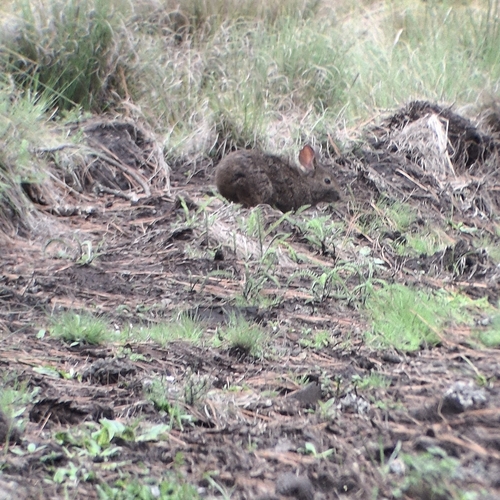
It is the second smallest rabbit in the world and one of the few lagomorphs that almost does not move its tail, a distinctive feature that helped to place it in its own genre, separated from all other American rabbits and liebres. It lives exclusively on the slopes of a handful of volcanoes surrounding Mexico City, hidden between dense mattresses of a high grass called zacatón that serves him both as food and as a shelter against predators. Unlike other rabbits, it builds a network of slopes and little deep mattresses among the macollas of that grass, where it moves almost without ever exposing itself to open sky.
Very small rabbit, of the smallest in the world, short and rounded ears, virtually invisible tail, and dark gray brown fur. It differs from other rabbits and liebres of the Central Mexican region by its much smaller size, short ears, the absence of visible tail, and by living always associated with dense carpets instead of on open ground.
Small footprint, 2-2.5 cm, with 4 fingers on each foot, smaller and more compact than that of a liebre or a mountain rabbit, without the pattern of jumping so lengthy typical of other lephorites. Rounded excrete, 4-6 mm, left in small clusters within the network of trails that excavates between the macollas of zacatón. The most characteristic signal is its own network of slopes and slopes little deep under the dense grass, with flat tunnels visible when aparting the vegetation, and clusters of straw of zacatón cut in a clean angle next to the entrances.
Density of high mountain zacatón, on the slopes of volcanoes, generally between 2800 and 4250 m of altitude. Endemic of a very reduced area around the Sierra Chichinautzin and Sierra Nevada, in the center of Mexico, near Mexico City.
Herbivorous, it feeds mainly on zacatón and other high mountain grasses, supplemented with crust and occasional grass according to seasonal availability.
It lives in small family colonies within a network of trails and walkways excavated between dense grass, with acute vocalizations used to communicate between individuals, a rare feature among rabbits.It is mainly crepuscular and nightlife activity, and does not migrate, remaining within a fixed territory associated with a concrete zacatón massive.
Its population, estimated at less than 7,000 individuals, is considered to be in continued decline by the loss and fragmentation of the dew of zacatón that it depends on strictly, aggravated by fires increasingly frequent in its distribution area.
Loss and fragmentation of zacatón groves by fires, cattle grazing and urban expansion on the slopes of volcanoes surrounding Mexico City, and occasional furtive hunting.
See all species accounts for rabbits and hares · Full species index
Mammaling is a free app for logging the mammals you find. You record a sighting in a moment — even if it's just a track — your life list grows, and the record becomes available to scientific and conservation projects.
It runs on your phone with nothing to install. If you like, it adds to your home screen like any other app.
Open Mammaling