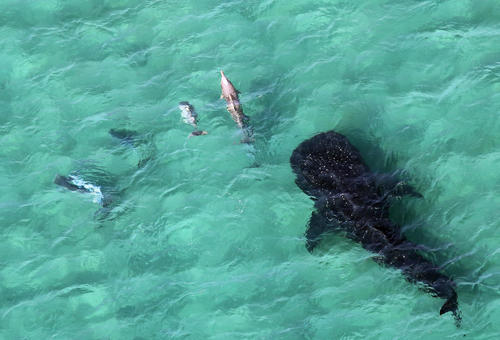
The Indo-Pacific Bottlenose Dolphin is easily confused with the Common Bottlenose Dolphin. For a long time, it was thought to be merely a population of that species. However, genetic and morphological studies confirmed it is a distinct species, adapted to the warm, shallow waters of the Indian and western Pacific Oceans. The Indo-Pacific Bottlenose Dolphin features in some of the most cited animal behaviour studies, including populations that use sea sponges as tools to protect their snouts while foraging on the seabed, a tradition passed from mothers to daughters. The Indo-Pacific Bottlenose Dolphin lives in coastal waters very close to densely populated human areas across much of its range, which directly exposes it to fishing and maritime traffic.
The Indo-Pacific Bottlenose Dolphin is a medium-sized dolphin, somewhat more slender than the Common Bottlenose Dolphin, with a proportionally longer beak. In many populations, it also has dark spotting on the belly that intensifies with age, a feature absent in the Common Bottlenose Dolphin. It is easily confused with the Common Bottlenose Dolphin where their distributions overlap at the western limit. Ventral spotting and cranial details are the most reliable features for distinguishing the two species.
The Indo-Pacific Bottlenose Dolphin leaves no tracks on land; it is detected by its surface behaviour, with frequent leaps and tail slaps, and by curiously approaching boats. Underwater, it emits characteristic individual whistles and echolocation clicks used for hunting and social cohesion. In some populations, it can be observed using marine sponges held to its snout while foraging for food on the sandy seabed, a culturally transmitted
Shallow coastal waters, bays, estuaries and reefs, generally close to the coast and rarely in deep open sea. Distributed throughout the Indian Ocean and western Pacific, from southern Africa and the Red Sea to Southeast Asia, southern China and northern Australia.
It feeds on a wide variety of coastal fish and cephalopods, caught using highly varied hunting techniques depending on the population, including the use of tools to forage on the seabed.
Highly social, the Indo-Pacific Bottlenose Dolphin lives in groups of fluid composition. Complex and lasting social bonds exist among some individuals, particularly among males that form multi-year alliances. It shows strong fidelity to a reduced coastal territory in many populations, which makes it especially vulnerable to local habitat degradation.
Coastal populations of the Indo-Pacific Bottlenose Dolphin are highly exposed to human activity in shallow waters throughout their range. They show signs of decline in several regions, mainly due to bycatch in fishing gear. This led to the species being re-evaluated from a category of Least Concern to its current status.
Bycatch in coastal fishing gear, degradation of reef and mangrove habitats, pollution, and in some areas, capture for the dolphinarium trade.
See all species accounts for even-toed ungulates · Full species index
Mammaling is a free app for logging the mammals you find. You record a sighting in a moment — even if it's just a track — your life list grows, and the record becomes available to scientific and conservation projects.
It runs on your phone with nothing to install. If you like, it adds to your home screen like any other app.
Open Mammaling