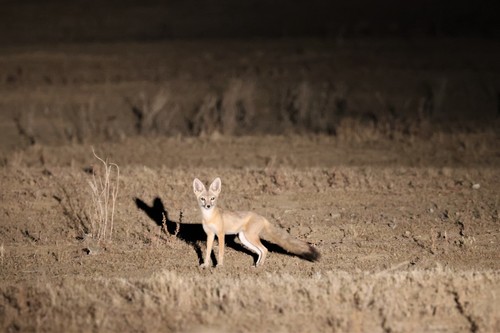
It is the smallest fox in North America, barely the size of a large domestic cat, with disproportionately large ears that serve it both to hear the movement of a prey underground and to dissipate the extreme heat of the desert where it lives. It excavates its own frogs, often with several entrances, in the loose soil of arid and semi-desert plains of the southwest of North America, where it passes the day protected from heat and goes hunting during the night. One of its subspecies, restricted to the valley of San Joaquín in California, has seen its habitat reduced to a minimum fraction of the original by the agricultural and urban expansion, and today survives in fragmented populations despite the fact that at the scale of the whole species the situation is much more favorable.
It is very small in size, yellow-to-grey brown fur, very large ears in proportion to the head, and long tail with the black tip. It differs from the fast fox, very similar, mainly by the distribution area and by a slightly larger ears; from other larger canids of its area it is immediately distinguished by its much smaller size.
Footprint with 4 fingers and thin nail marks, 3-3.5 cm, notably smaller than that of a coyote and with a very straight walking trail owned by the small desert canyons. Thin and lengthy feces, 4-6 cm, with visible rodent hair, deposited near the entrance of the cranberry or in elevated points of the territory. The most diagnostic signal is the cranberry itself: a system with several entrances, 15-20 cm in diameter, excavated in loose ground of open plain, often reusing and expanding cranberry of other excavatory species.
Desert, bush and semi-desertic plain, from low lands to medium cotes.Distributed by the southwest of North America, from the west of the United States to the center of Mexico.
Carnivorous, it is mainly fed by nighttime rodent and insect, complemented with bird and occasional wild fruit, obtaining much of the water it needs directly from prey.
It lives in stable couples that share territory and often several alternate nurses within it.It is strictly nocturnal, remaining underground during the hottest hours, and the offspring remain with the parents several months after birth.
At the scale of all the species, its populations are generally considered stable, although the sub-species of the San Joaquín valley, in California, survives in very fragmented populations and reduced by the historical loss of its original habitat.
Conversion of desert habitat and dirt to agricultural and urban land in some areas, and road crashes.
See all species accounts for carnivores · Full species index
Mammaling is a free app for logging the mammals you find. You record a sighting in a moment — even if it's just a track — your life list grows, and the record becomes available to scientific and conservation projects.
It runs on your phone with nothing to install. If you like, it adds to your home screen like any other app.
Open Mammaling