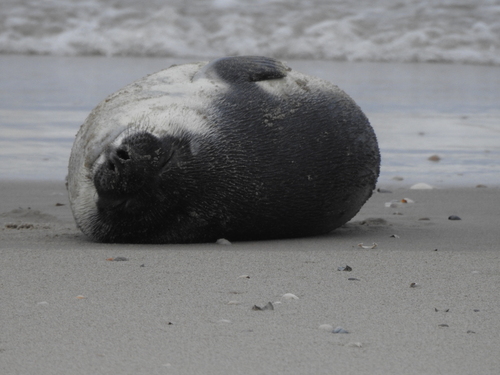
The male Hooded Seal has one of the most extravagant adornments in the entire animal kingdom: an elastic skin sac over its snout. It can inflate this sac like a balloon to double the size of its head. It can also project it outwards through one nostril as a bright red bladder. Both are used to intimidate rivals and attract females. It lives in some of the coldest waters of the North Atlantic, breeding on drifting sea ice floes for an astonishingly brief period. Young are weaned in just four days, one of the shortest lactation periods known among mammals. Its strong dependence on Arctic sea ice has made it one of the seals whose situation has deteriorated most rapidly in recent years.
A large Hooded Seal with silver-grey fur, very distinct irregular dark spots, and a large, robust head. The adult male has a prominent inflatable nasal sac on its snout, absent in the female, which gives it an unmistakable appearance among North Atlantic seals.
It does not leave tracks in the usual sense, but it does leave drag marks on ice or shingle beaches. Droppings are liquid and are rarely found on land. The clearest sign of its presence is solitary young on drifting ice floes, which have very characteristic bluish-grey fur from birth, unlike other Arctic seals born with white lanugo. Also indicative are the guttural sounds and the display of the male's nasal sac during territorial confrontations.
Cold, deep waters of the North Atlantic and Arctic, with breeding colonies on drifting sea ice in very specific areas far from the coast. Distributed across the North Atlantic, from eastern Canada to Greenland, Svalbard, and the Barents Sea.
It feeds on a wide variety of deep-water fish and cephalopods, caught during dives that can exceed several hundred metres.
The Hooded Seal forms dispersed breeding colonies on drifting ice floes. Lactation is extraordinarily short, lasting only about four days, after which the mother abandons the young. The young must then fend for themselves much earlier than most seals. Outside the breeding season, it is more solitary and undertakes extensive movements, following the sea ice and prey availability.
The Hooded Seal has moved in recent years from a situation of least concern to a much more precarious one, with a documented decline in several of its breeding areas. Most recent assessments attribute this primarily to the accelerated loss of sea ice in the North Atlantic and the Arctic.
Loss of sea ice due to climate change, reducing and destabilising its breeding platforms; historical and current capture in some Arctic fisheries; and pollution by persistent compounds that accumulate in fat.
See all species accounts for carnivores · Full species index
Mammaling is a free app for logging the mammals you find. You record a sighting in a moment — even if it's just a track — your life list grows, and the record becomes available to scientific and conservation projects.
It runs on your phone with nothing to install. If you like, it adds to your home screen like any other app.
Open Mammaling