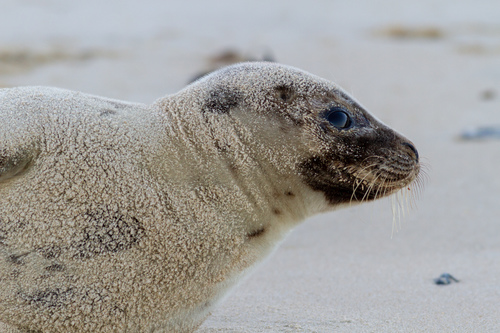
Harp Seals are born with pure white fur. This insulating layer gives them their popular name in several languages. They lose this fur in a few weeks, giving way to the adult's mottled grey pattern. This change in coat is so rapid that an individual can be unrecognisable between birth and its first summer. Its entire life cycle is synchronised with the advance and retreat of sea ice
A medium-sized Harp Seal, adults have silver-grey fur with an irregular harp- or horseshoe-shaped pattern of dark spots on the back, more pronounced in males than females. Young are born with pure white fur, which they moult within a few weeks. It differs from other Arctic seals due to the adult's characteristic harp-shaped spot pattern and its close association with floating sea ice, where it forms large, highly visible breeding aggregations.
The Harp Seal does not strictly leave tracks on land, as it almost always gives birth and rests on floating sea ice. On snow, it may leave a continuous body drag trail with lateral flipper marks at regular intervals, distinct from the hopping gait of other seals.
It forms large breeding aggregations on ice floes, with white-coated young highly visible from a distance, grouped in colonies that can number thousands of individuals.
Underwater, it emits varied vocalisations used in social communication. Its presence on dry land outside the Arctic is usually associated with episodes of straying or poor body condition.
Arctic and subarctic waters of the North Atlantic, breeding on floating sea ice in specific areas of the Northwest Atlantic, the Greenland Sea and the White Sea. It undertakes annual migrations of thousands of kilometres between summer feeding grounds in Arctic waters and winter breeding grounds further south on the ice.
It feeds on pelagic fish such as Capelin and Herring, as well as crustaceans, caught by diving in cold waters near sea ice.
Highly migratory and gregarious, the Harp Seal forms large breeding aggregations on sea ice in winter and spring, with very marked reproductive synchronisation linked to ice availability and stability. The young remain on the ice while the mother alternates suckling periods with feeding dives.
Its status has been reclassified as of greater concern in the most recent assessment, following evidence of a decline linked to reduced and less stable sea ice in several North Atlantic breeding areas. This decline reverses the recovery trend observed after decades of regulated commercial hunting.
Loss and reduced stability of breeding sea ice due to climate change increases young mortality when Harp Seals give birth on thinner or unstable floes. Other threats include regulated commercial and indigenous hunting, which continues in some countries, and bycatch in fishing gear.
See all species accounts for carnivores · Full species index
Mammaling is a free app for logging the mammals you find. You record a sighting in a moment — even if it's just a track — your life list grows, and the record becomes available to scientific and conservation projects.
It runs on your phone with nothing to install. If you like, it adds to your home screen like any other app.
Open Mammaling