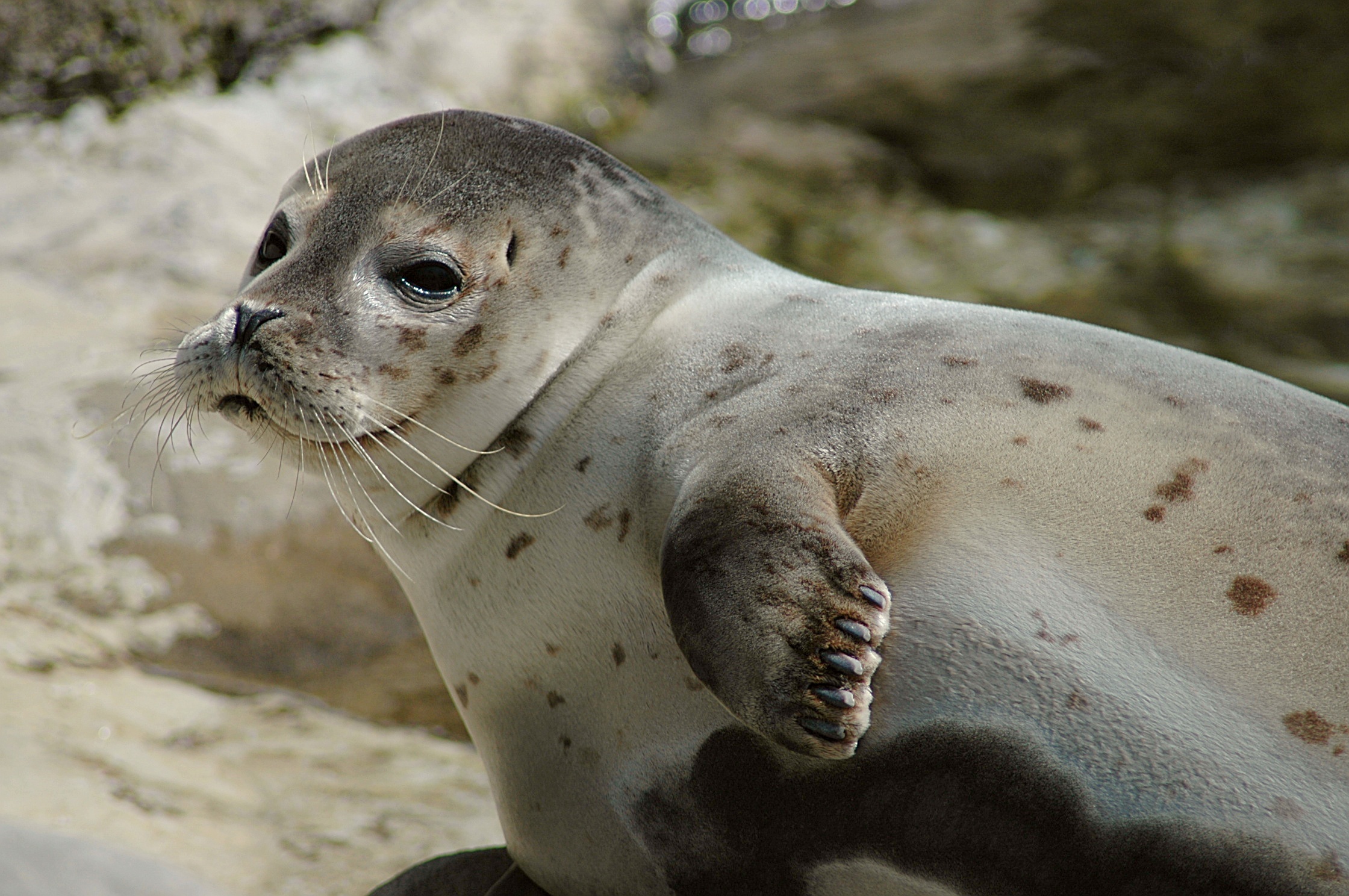
Despite its name, the Harbor Seal is not always the easiest seal to see on some coasts. It prefers discreet sandbanks where it rests during low tide, always ready to slide into the water at any sign of danger. It is the most widely distributed seal in the Northern Hemisphere, present on both Atlantic and Pacific coasts. Some populations even ascend rivers and settle in freshwater lakes close to the sea. Its young are born already able to swim within hours of birth, a trait not seen in most other seals.
The Harbor Seal is a medium-sized seal with a robust, spindle-shaped body. Its coat pattern of spots is highly variable, ranging from light grey to dark brown. It has a rounded head without external ears and a V-shaped concave facial profile. It can be confused with the Grey Seal, which is notably larger and has a straight or convex facial profile (often described as a 'horse head'). In close sightings, they are easy to differentiate.
It does not leave tracks in the usual sense, but creates characteristic drag marks when moving across beaches, sandbanks or ice, with marks of its fore flippers on the sides. Droppings are liquid and rarely found on land. The most reliable signs are groups hauled out on sandbanks, rocks or ice at low tide, and guttural underwater vocalisations during oestrus.
Rocky coast, estuary, sandbank and coastal ice in temperate and Arctic waters; in some populations it ascends rivers and establishes itself in freshwater lakes close to the coast. Circumpolar distribution in the Northern Hemisphere, on both coasts of the North Atlantic and North Pacific.
It feeds on a wide variety of fish, cephalopods, and crustaceans, caught by diving close to the coast. Its diet is highly dependent on local availability.
The Harbor Seal is gregarious in resting areas but mostly solitary when feeding. It sheds its coat once a year in summer, a period when it spends more time on land.
Females give birth to a single young, which is able to swim within hours of birth, unlike other seals whose young remain on land for several weeks.
Populations are stable or increasing across most of their range, although with strong regional variations. Some Baltic and European inland sea populations are still recovering from historical morbillivirus outbreaks, while the isolated subspecies in the Ungava lakes of northern Canada is in a much more precarious conservation status.
Epidemic outbreaks of morbillivirus (phocine distemper), bycatch in fishing gear, hydrocarbon pollution, and historical persecution due to conflict with fisheries.
Photographs by Mammaling users, published under a Creative Commons Attribution-NonCommercial licence.
See all species accounts for carnivores · Full species index
Mammaling is a free app for logging the mammals you find. You record a sighting in a moment — even if it's just a track — your life list grows, and the record becomes available to scientific and conservation projects.
It runs on your phone with nothing to install. If you like, it adds to your home screen like any other app.
Open Mammaling