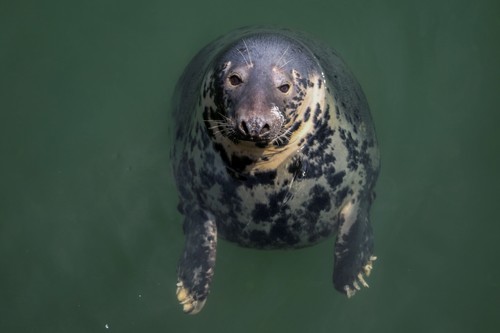
The Gray Seal is the largest seal breeding on the temperate coasts of the North Atlantic. Its breeding colonies are among the noisiest and most numerous wildlife spectacles on those coasts, with males openly fighting for access to females. Males and females barely resemble each other: the male, with his thick neck and straight profile earning him the nickname "horse head", can weigh up to three times as much as the female. Its populations have recovered strongly from their early 20th-century lows, although the Baltic Sea population remains much smaller and more vulnerable than those in the rest of its range.
The largest temperate seal of the North Atlantic, the Gray Seal exhibits marked sexual dimorphism. Males are much larger, with thick necks and a straight or convex facial profile ('horse head'), while females are smaller and more slender. Spotting patterns are highly variable. It differs from the Common Seal by its larger size and straight facial profile, compared to the latter's concave V-shaped profile.
The Gray Seal does not leave distinct tracks, but it does leave wide drag marks on beaches and sandbanks. These are more pronounced than those of the Common Seal due to its larger size. Droppings are liquid and rarely found on land. Breeding colonies on land or ice, with young displaying very conspicuous white woolly fur during their first weeks of life, and the grunts and roars of males disputing access to females, are the clearest signs of its presence.
Exposed rocky coasts, islands, and sandbanks of the North Atlantic, with breeding colonies on land or on ice depending on the region.
It is distributed in two main populations: one in the Northwest Atlantic (Canada) and another in the Northeast Atlantic (British Isles, Baltic Sea, Iceland, Norway), with no presence in the Pacific.
The Gray Seal feeds on a wide variety of fish, predominantly benthic and demersal species depending on the area, caught during dives that can exceed several minutes.
The Gray Seal forms large, very dense, noisy breeding colonies at a specific time of year. This varies by region: autumn in the Northwest Atlantic, and autumn-winter in much of the Northeast Atlantic. Males actively compete for access to females through fights. Outside the breeding season, the Gray Seal is more dispersed, feeding solitarily at sea.
The Gray Seal has recovered remarkably in much of its range from historical lows in the early 20th century, caused by hunting. Populations in the Northwest Atlantic and the British Isles are showing sustained increase. However, the much smaller, isolated Baltic Sea population remains a cause for regional concern.
Bycatch in fishing gear, direct conflict with fisheries (leading to occasional lethal control in some regions), pollution and, in the Baltic Sea, persistent pollutants that have historically affected reproduction.
See all species accounts for carnivores · Full species index
Mammaling is a free app for logging the mammals you find. You record a sighting in a moment — even if it's just a track — your life list grows, and the record becomes available to scientific and conservation projects.
It runs on your phone with nothing to install. If you like, it adds to your home screen like any other app.
Open Mammaling