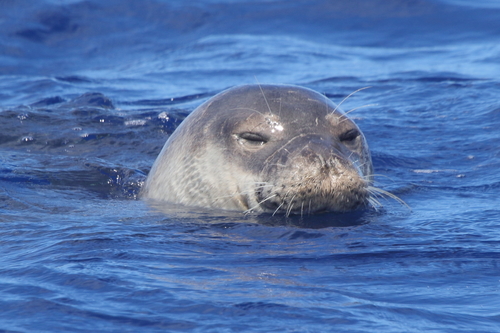
The Mediterranean Monk Seal is one of the most endangered seals on the planet and the only pinniped species to live permanently in the Mediterranean, a sea where most people do not expect to find seals. It was on the verge of complete disappearance in the 20th century, reduced to a handful of scattered colonies hidden in almost inaccessible sea caves. This sheltered breeding behaviour developed in response to centuries of human persecution. In recent years, it has undergone a slow but real recovery, with increasingly frequent sightings on open beaches in areas where it had not appeared for decades. Specialists interpret this behavioural change as a hopeful sign.
The Mediterranean Monk Seal is a large seal with a robust body. Its fur is dark greyish-brown to black in adult males, and lighter in females and juveniles, often with an irregular white patch on the belly. It differs from other seals because it is the only pinniped species that breeds regularly in the Mediterranean and subtropical North-east Atlantic. It does not overlap with any other seal over much of its range.
The Mediterranean Monk Seal does not leave tracks in the usual sense. However, it leaves drag marks on the few beaches or rocky ramps that provide access to the caves it uses for resting and breeding. Droppings are liquid and rarely found on land. The most reliable signs of its presence are the marine caves themselves, with an interior beach, where it takes refuge, and the guttural vocalisations that can be heard from outside in the most active breeding colonies.
Rocky coasts with sea caves with semi-submerged access, and increasingly also open beaches in areas with less human pressure.
Its distribution is very fragmented, spanning the eastern Mediterranean Sea and the north-eastern Atlantic off the coasts of Mauritania and the Madeira archipelago. Population centres are very widely separated.
It feeds on a wide variety of bottom-dwelling and mid-water fish and cephalopods, caught during dives relatively close to the coast.
Historically, the Mediterranean Monk Seal was solitary, sheltering in almost inaccessible caves in response to human persecution. This is an unusual behaviour for seals, which typically breed on open, exposed beaches. In recent years, however, an increasing use of open beaches for resting has been observed in areas where human pressure has decreased. This suggests a possible recovery of the species' more natural behaviour.
At the end of the 20th century, the global population of the Mediterranean Monk Seal numbered only a few hundred individuals. It is now considered to be in slow and sustained recovery thanks to strict legal protection and the monitoring of the most important breeding colonies. However, it remains distributed in small, highly isolated populations, making it vulnerable to specific events.
Bycatch and direct persecution due to conflict with artisanal fishing, degradation and disturbance in breeding caves from coastal tourism, marine pollution, and the small size and genetic isolation of most of its population nuclei.
See all species accounts for carnivores · Full species index
Mammaling is a free app for logging the mammals you find. You record a sighting in a moment — even if it's just a track — your life list grows, and the record becomes available to scientific and conservation projects.
It runs on your phone with nothing to install. If you like, it adds to your home screen like any other app.
Open Mammaling