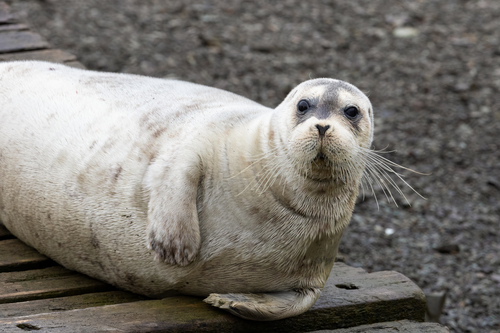
Its name comes from its long, white, highly sensitive whiskers, which it uses as a tactile map of the seabed, tracking clams, crabs, and other invertebrates buried in the sediment even in complete darkness beneath the Arctic ice.
During the breeding season, males sing a long, distinctive descending trill underwater. It is so characteristic that scientists studying Arctic seals recognise it instantly. This sound travels several kilometres beneath the ice, serving both to attract females and warn other males.
Their young are born able to swim within hours, an unusual trait among newborn mammals that allows them to escape predators such as the Polar Bear almost from their first day of life.
The Bearded Seal is a large seal, the largest of the true Arctic seals alongside the Elephant Seal (though of very different dimensions). It has a robust, brownish-grey body with variable darker markings, a head small in proportion to its body, and very long, dense whiskers that appear curly when dry, much more developed than in any other Arctic seal. It is distinguished from other seals in its range precisely by these long, characteristic whiskers and its notably larger size.
The Bearded Seal does not leave conventional tracks on land, because it is associated with sea ice and shallow coastal waters. On snow, it may leave a continuous body drag track with flipper marks at regular intervals. Its most characteristic sign is acoustic: the descending trilling song emitted by males underwater during the breeding season. This is audible with a hydrophone several kilometres away and is used by researchers as the primary method for indirect census of the Bearded Seal. On ice, Bearded Seals can be detected near breathing holes of a larger diameter than those of other seals, consistent with their larger body size.
Arctic and subarctic waters over shallow continental shelves, with a strong association with drifting sea ice over bottoms rich in benthic invertebrates, rarely in deep water. Distributed circumpolarly throughout the Arctic, present in the North Atlantic, North Pacific and much of the Russian and Canadian Arctic waters.
The Bearded Seal feeds mainly on benthic invertebrates such as clams, crabs, and marine worms, as well as bottom-dwelling fish. It locates these using its long, sensitive whiskers when foraging on the seabed sediment.
Generally solitary or in small, loosely cohesive groups, with a strong association with drifting sea ice for resting, moulting, and breeding. Males emit complex underwater songs during the breeding season to attract females and compete with other males. Young are born already able to swim proficiently a few hours after birth.
Its status was assessed as of greater concern in the most recent evaluation. Signs of decline are linked to the loss and reduced stability of sea ice in several Arctic areas. However, the larger populations in the Russian and Canadian Arctic remain relatively abundant for the time being.
Loss and reduced stability of shelf sea ice due to climate change reduces the availability of resting and breeding areas over prey-rich seabeds. Regulated indigenous hunting continues in some Arctic communities. Maritime traffic and industrial activity are increasing in areas previously covered by permanent ice.
See all species accounts for carnivores · Full species index
Mammaling is a free app for logging the mammals you find. You record a sighting in a moment — even if it's just a track — your life list grows, and the record becomes available to scientific and conservation projects.
It runs on your phone with nothing to install. If you like, it adds to your home screen like any other app.
Open Mammaling