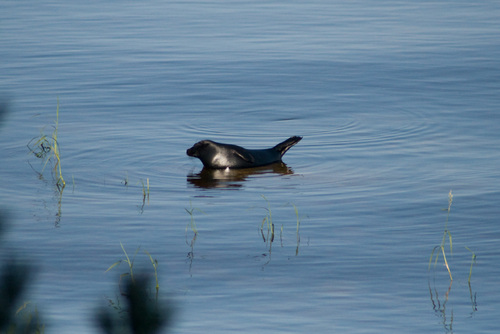
The Ringed Seal can live year-round in areas where the sea remains almost continuously frozen, thanks to especially robust fore claws which it uses to scrape and keep open breathing holes in ice over a metre thick. The female excavates a small, hidden cave under the snow accumulated over these holes, where she gives birth to her young. This refuge protects her from both extreme cold and predators such as the Polar Bear, and is almost invisible from the surface. It is also the only Ringed Seal capable of maintaining permanent populations in freshwater lakes completely isolated from the sea. Some of these populations have been separated from the ocean for thousands of years and are today among the most threatened marine mammals on the planet.
The Ringed Seal is a small to medium-sized seal with grey fur. Its fur has dark spots, each surrounded by a lighter halo, which gives the species its common name. It has a small, rounded head and robust front claws adapted for scraping ice.
It differs from other Arctic seals by this very characteristic pattern of spots with a light halo, and by its notably smaller size. Indeed, it is one of the smallest seals in the Northern Hemisphere.
The Ringed Seal does not leave conventional tracks on land, as it lives almost always associated with sea ice. On snow, it may leave a body drag track with marks from its fore flippers at short intervals. The most characteristic sign of its presence are breathing holes, kept open in the ice by repeated scraping with its fore claws. These are visible as circular openings about 20-30
Arctic and subarctic sea ice of all types, from fast ice to open-sea drift ice, and exceptionally, freshwater lakes completely isolated from the sea in northern Europe.
The Ringed Seal is distributed circumpolarly throughout the Arctic. Relict lake populations have a much more critical conservation status than the main marine population.
It feeds on small pelagic fish and crustaceans, caught by diving under the ice, partly guided by the breathing holes that it actively keeps open.
Ringed Seals are solitary for most of the year. Females dig birthing lairs hidden under snow on ice, where they give birth to and nurse a single young. The Ringed Seal is the least gregarious seal in the Arctic. Its strong dependence on stable sea ice completely dictates its distribution and annual reproductive success.
The Arctic marine population remains numerous, though showing signs of local decline due to the loss of stable ice. In contrast, the relict lake populations in northern Europe, isolated from the sea for thousands of years, are in a much more critical situation and have been assessed separately in higher threat categories.
Loss of stable sea ice due to climate change, reducing the availability of safe areas for excavating breeding dens. Premature collapse of snow dens in winters with less snowfall. In relict lake populations, entanglement in freshwater fishing gear and lake habitat fragmentation.
See all species accounts for carnivores · Full species index
Mammaling is a free app for logging the mammals you find. You record a sighting in a moment — even if it's just a track — your life list grows, and the record becomes available to scientific and conservation projects.
It runs on your phone with nothing to install. If you like, it adds to your home screen like any other app.
Open Mammaling