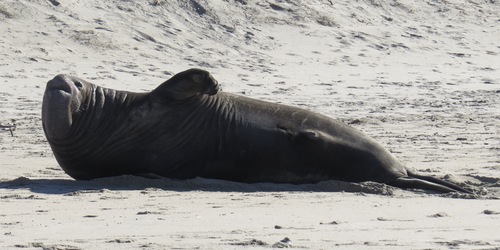
The adult males, which can weigh more than three tons, quadruplicating the weight of the females, carry every winter violent battles on the breeding beaches by the control of large harens, using as a weapon both their uncommon size and an inflatable tube that amplifies the rugs with which they intimidate their rivals. It is an extreme diver able to descend more than 1500 meters and remain submerged up to two hours, spending most of its life in the open sea and returning to land firm only to reproduce and to change the skin. At the end of the 19th century the commercial hunting reduced it to a population of only a few dozen individuals on a single Mexican beach, one of the most extreme bottle necks documented in a mammal, from which the species has recovered up to the tens of thousands of current
Pinnípedo of large size, with a marked sexual dimorphism: the males are much larger than females, of gray skin and with a prominent inflable trumpet that only appears from sexual maturity; females lack trumpet and are of smaller size. It differs from the austral marine elephant, with which it does not coincide in area, and from other pinnípedos of the American Pacific coast by its much larger size and, in the adult male, by that characteristic trumpet.
Footprint does not apply in the usual sense; in the sand leaves a trail of widening wide and continuous, up to 1 m wide, produced by moving through body ondulations instead of walking over the extremities, very different from the trail of individual legs of other pinnípedos with more mobility on the ground. In mud beaches leaves large accumulations of skin and hair unleashed in plates.
Coastal and oceanic waters of the American Pacific, with sandy or rocky beaches of access reserved for reproduction and mud. Distributed along the Pacific coast, from Mexico to northern California and Oregon.
Carnivorous, it feeds on fish and deep-water calamar, caught during very prolonged immersions in the open sea.
It forms very numerous harens on breeding beaches, with a dominant male defending access to dozens of females versus other males.It spends most of the year in the open sea alone, making long migrations and extreme immersions, and returns to land only to reproduce and change the skin once a year.
Its population has recovered strongly from the historical bottleneck of the late 19th century to several tens of thousands of individuals, with a general trend of increasing or stable in most of its breeding colonies.
Low genetic diversity inherited from the historical bottleneck, which could limit its future adaptability, and risk of plot in fishing and marine pollution.
See all species accounts for carnivores · Full species index
Mammaling is a free app for logging the mammals you find. You record a sighting in a moment — even if it's just a track — your life list grows, and the record becomes available to scientific and conservation projects.
It runs on your phone with nothing to install. If you like, it adds to your home screen like any other app.
Open Mammaling